

Yala National Park: Location, Access, and Facilities
|
|
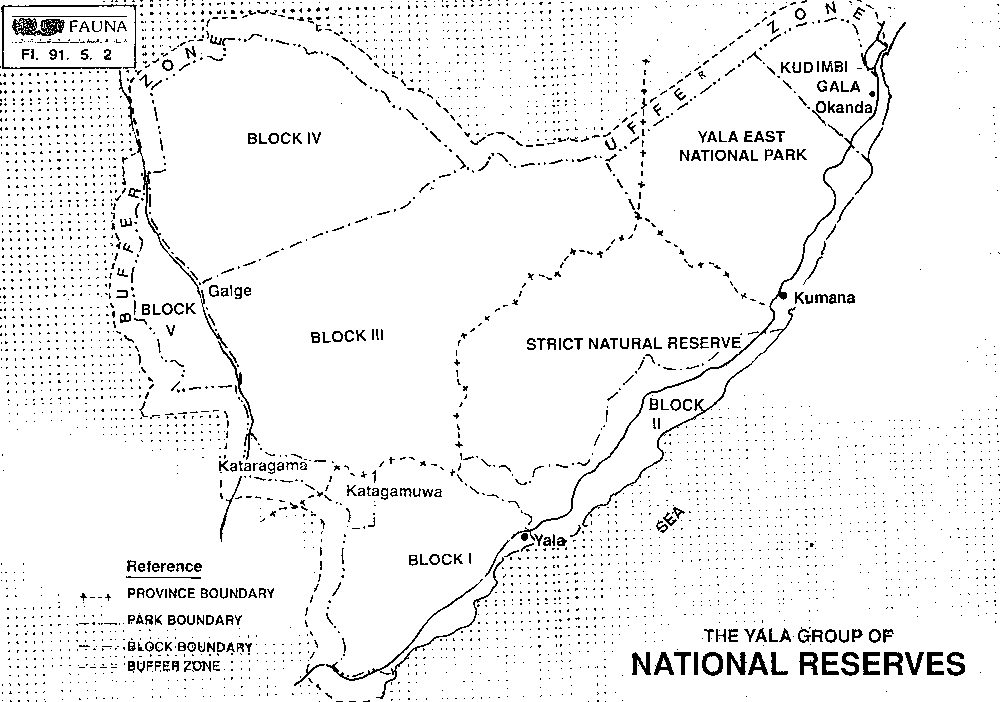
Map of Yala National Park. Click on the map to view at full size. |
 |
 |
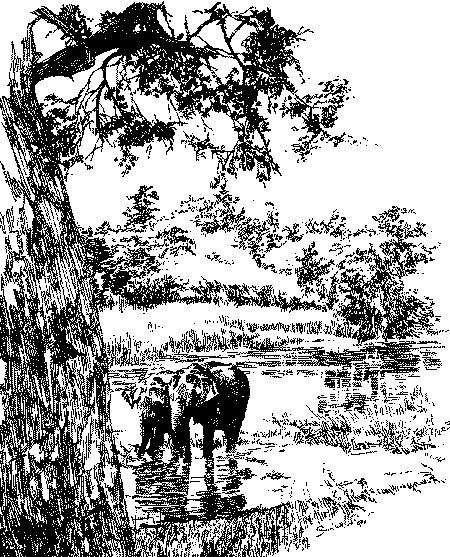
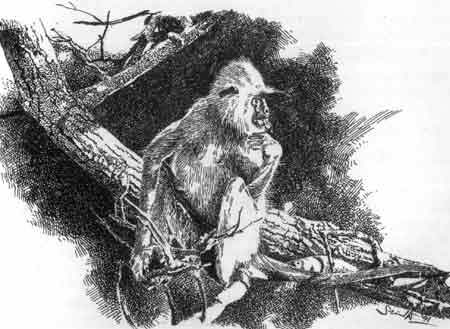
| The Kataragama Pada Yatra pilgrims typically take five or six days to cross Yala National Park from Panama to Kataragama. The Park is a refuge for wild game like elephants, leopards and langurs (below). |
 |
Yala National Park is geographically located in Sri Lanka at latitude 06°16' - 06°42' North and longitude 81°15' - 81°42' East. The Park can be visited via the town of Tissamaharama in the Hambantota District of the Southern Province.
While Block I has good access roads, access to Blocks II and III is limited mainly to dry weather. There are eight Park bungalows all of which are within Yala Block I. Another has been constructed at Katagamuwa Sanctuary, and one more is now ready for occupation in Yala Block IV. Accommodation is available for 8-10 people in each bungalow on the basis of prior reservations with the Department of Wildlife Conservation. Apart from resident visitors occupying the bungalows, a large number of day visitors enter the Park.
The Block I boundaries of the Park, take in 19 kilometers of sea coast in the southeast from Amaduwa to Yala, 19 kilometers from Yala up the Menik Ganga to Pahalahentota, 19 kilometers from Pahalahentota to Bambawa, and 3 kilometers from Bambawa to Palatupana.
Early History
"The earliest epigraphic "Brahmi" inscriptions discovered in Sri Lanka and in this region date back to the 2nd century B.C. Prior to this the Indo-Aryan settlers from Northern India as represented,in the legend of Vijaya, were well established and in full control of the area. Edifices of the earliest Buddhist cave monastery type began to be constructed wherever there was human habitation and in suitable rock outcrops, of which there are many in the area. There are to this day innumerable and very interesting remains of cave dwellings from the pre-Christian era."
This region was part of the Rohana (Ruhuna) Kingdom, having an advanced civilization as evinced by remains of dagabas and ancient artificial reservoirs (tanks), built by clever hydrological engineers, to irrigate large extents of cultivable land.
After the 10th century, historical evidence draws attention to the absence of inscriptions later than the 10th century A.D. "Architectural and sculptural remains of the medieval period are absent. It would appear to be a justifiable inference that some sudden de-population of the region occurred. The ancient chronicles supply no information whatsoever and the jungle tide spread covering the past with a mantle of secondary forest. These have matured to the climax stands seen in Yala today.
The Modern Era
At the turn of the century Yala Block I was declared a Game Sanctuary. A small area west of the Sanctuary was set aside in which resident sportsman might shoot. The main force behind this decision was the Game Protection Society (now the Wildlife and Nature Protection Society) founded in 1894 by the plantation owners, executives of firms, sportsmen and amateur naturalists favouring the conservation of wildlife. Records denote that the first Game Ranger of the Sanctuary was H.H. Engelbrecht, an Afrikaaner and a Boer prisoner of war who was not returned to South Africa on account of his refusal to swear allegiance to the British monarchy. After his release Engelbrecht came to the nearby coastal town of Hambantota. Being on his own on foreign soil, he found life hard. The Government Agent of the district however, took pity on Engelbrecht and made him the custodian of the Game Sanctuary around 1908. With his experience of wildlife on the veldt, the post suited him admirably. He administered the region fearlessly and with courage, using his whip to punish any miscreants. Many are the tales of his daring and prowess with the gun. However, his German ancestry proved to be his undoing. He was falsely accused during the First World War (1914-1918), of supplying meat to a German warship, the "Emden", and was taken into custody. After the war, he was released and once again returned to Hambantota where he died in poverty. Long after his death, it was proved that he was innocent of the accusation.
Climate
Being located in one of the arid regions of Sri Lanka, the climate of Ruhuna National Park is usually hot and dry. The area receives its annual rainfall during the north east monsoon from November to January, and unpredictable inter-monsoonal rains in March/April and September. February is a dry month, with the dry season proper commencing in June and lasting until September and sometimes until mid October.
The mean annual temperature near sea level is 270C, although in the dry season a daily maximum of 370C is not uncommon.
Physical features
"Most of the area is underlain by Vijayan rocks formed over 600 million years ago. Rock outcrops or inselbergs stand out of a relatively flat plain, looming to heights of up to 800ft. They are made up of migmatites, hornblende, and granite gneisses. Pleistocene and Holocene alluvial and aeolian deposits cover the Vijayan series near the Menik ganga and along most of the coast line."
The Menik Ganga is now a seasonal river, since its damming for irrigation purposes higher up, as far back as 1878. There are four other seasonal "aras" or streamlets carrying water during the rainy season.
The breached and denuded earth bunds of several irrigation tanks are still visible, together with natural water holes and tanks (wewa), improved to hold water. These sources of water are a link in the survival of the wildlife found within the area.
Amongst the rock ridges and monoliths are several natural rock pools that have a charm of their own. Some contain water throughout the year, and have their own development of water plants and fauna.
In the southeast, the Park is bounded by the sea. The many bays carve out an intricate mosaic. Unspoilt natural beaches and sand dunes provide a beautiful environment of undulating and shifting sands. This is surely one of the most spectacular seascapes of Sri Lanka. Far out at sea are two lighthouses, Great and Little Basses, which stand on two submerged ridges by those names and beam a red and white light respectively at night.
Lagoons fringe this part of the coastline, each lined with mangroves and filled with brackish water. The extensive parklands that surround these lagoons offer visitors superb locations for viewing animals and bird life.
Fauna International Guide to the Ruhunu (Yala) National Park copyright 1993 text by Childers Jayawardhana, former Warden, Yala National Park
Kataragama — Where Sinhala and Hindu Cultures are Interwoven
Kumudu Amarasingham explores Kiri Vehera
Few places lavish the luxury of extreme serenity and spiritual bliss just upon setting foot into it the way the Kiri Vehera temple in Kataragama does. While it is the Hindu Kataragama, with its myriad and colourful rituals and renowned deity that has captured the imagination of pilgrims’ world over, the more quietly ethereal Kiri Vehera, in its virgin whiteness, has a charm beyond the clash of colour and life that is so much a part of the venerable holy city.Kiri Vehera
Kiri Vehera is one of the five most important sites of worship in the city along with the Maha Bodhi, Kataragama Devale, Sella Kataragama and Vedihitikanda. The dagoba is also described in the stanzas as one of 16 most important pilgrimage sites in Sri Lanka
The 95 ft. tall Kiri Vehera has a circumference of 280 feet. It is milky white in colour, hence the name. It is situated near the well known Menik Ganga.
|
|
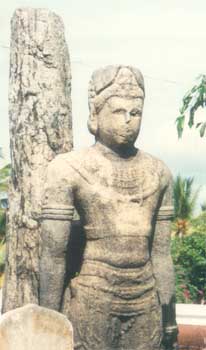
King Mahasena at Kiri Vehera
|
 |
|
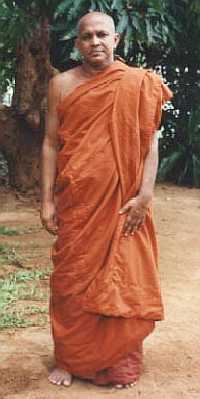
Ven. Dr. Aluthwewa Soratha
Thero of Kirivehera Raja Maha Viharaya |
There are many theories on the origin of the dagoba. Some believe it was built by Parakramabahu the Great of Polonnaruwa during the Third Century BC, on the request of Queen Subadra. Some think that it was first built by a local ruler named Mahasena on a site made hallowed by the Buddha’s visit.
Some believe that the vihara was originally known as Magul Maha Seya and although there are no clues as to who built it, the bricks used in the construction bear Brahmin inscriptions which point to King Mahanaga’s reign during the Third Century BC. Some records even date it to the first century BC.
The Buddha is believed to have paid a visit to Kataragama during His third visit to Sri Lanka. The Kiri Vehera is said to enshrine the golden seat the Buddha sat on during His sermon, a lock of His hair and the royal sword — magul kaduwa with which Prince Siddhartha cut off His hair at the Great Renunciation.
God Skanda
One beautiful story states that the God Skanda (Kataragama) shot an arrow from the Vedihitikanda (peak) vowing that where the arrow hit, there a temple would be built.
The place is also linked to the reign of Dappula I, Vijayabahu I and Kavantissa, the father of King Dutugemunu and Saddhatissa. However, the Kiri Vehera went into ruin with jungles covering much of the area after the Chola invasions of Polonnaruwa in the 12th century. A renovation programme was carried out at Kiri Vehera in 1912 and again in 1970.
While the Dalada Perahera ranks on top, the Kataragama festival is extremely important amongst the country’s social and cultural events – possibly because it amalgamates all races and religions to one spot.
The predominantly Hindu festival, conducted during July-August, contains some novel features such as kavadi dancers and fire walkers. It ends with a glittering perahera where elephants, chieftains, drummers and up country and low country dancers play a leading role. All Buddhists pay a visit to Kiri Vehera after the festival, and in most cases, before as well.
According to Ven. Soratha Thero of the Kataragama Kiri Vehera Devalaya Lord Buddha visited 16 places in Sri Lanka including Kataragama, and was graciously welcomed by the local ruler Mahasena or Mahagosha, who later became a disciple.
Legend has it that Mahasena, having taken refuge in the triple gem, vowed to remain and protect Buddhism in Sri Lanka.
Bodhisattva
Many Buddhists believe that God Kataragama is a Bodhisattva (one aspiring to be a Buddha) who has the power and compassion to intervene in the lives of those who appeal to him. While some scholars are of the opinion that God Kataragama was a local chieftain who was later elevated to the status of a deva, others proclaim Mahasena is still alive and rules to this day.
Local folklore aside though, the belief in the god and the reverence for the Kiri Vehera are deeply ingrained in the hearts of the people of Sri Lanka, and the deity and place of worship are one of the first things that come to mind in times of strife.
God Skanda is said to be one of the four deities guarding the Sinhala pantheon – though he is originally a vedic god.
If ever there was proof that the so-called Sinhala and Hindu cultures are intricately and inextricably interwoven, Kataragama perhaps above anything else, stands for it.


 Probably one senior monk renowned for his knowledge of the doctrines
would have slowly recited them, while monk-scribes wielded their styli
and positioned the olas. The others monks would almost certainly have
been involved in discussion when occasional questions of interpretation
arose. The process of transcription must have taken many years, for the
doctrines alone are said to be 11 times the length of the Bible, and
that's not counting the commentaries.
Probably one senior monk renowned for his knowledge of the doctrines
would have slowly recited them, while monk-scribes wielded their styli
and positioned the olas. The others monks would almost certainly have
been involved in discussion when occasional questions of interpretation
arose. The process of transcription must have taken many years, for the
doctrines alone are said to be 11 times the length of the Bible, and
that's not counting the commentaries.The library at Aluvihare, which had safely housed the volumes of this precious manuscript for so many centuries, was totally destroyed by the British during the Matale Rebellion of 1848. Along with it went much of the rest of the temple complex. This came about when the British pursued a notorious rebel leader to a hiding place in the rock caves nearby, and then set about punishing the neighbourhood. The consequences of this sacrilege are still evident today, for since that time generations of monks have been painstakingly rewriting the Tripitika. As there are only a few monks involved it is taking an extraordinarily long time - the first of the three 'baskets of the law' was only completed in 1982.
The tranquility of Aluvihare is in contrast to the better-known and more frequented rock temple at nearby Dambulla with its numerous caves shrines. Aluvihare has many caves, too, with ancient inscriptions, comparatively modern wall and ceiling paintings of interest, and impressive images of the Buddha. The main cave, for instance, has a large reclining statue of the Buddha 10m long, together with standing and seated images. In the vestibule of another cave with a reclining statue of the Buddha there are terrifying depictions of the hellish afterlife that awaits sinners. Some of these unfortunate beings are shown having their eyes pecked out by crows, being disembowelled, dismembered and impaled on spikes.
One cave is dedicated to the revered Indian monk-scholar Buddhagosa, who resided at Anuradhapura but is supposed to have spent several years here during the 4th/5th centuries AD. Buddhagosa, whose name means The Voice of Buddha, was regarded as the greatest exponent and interpreter of the Pali canonical scriptures. Born in North India, he was ordained as a monk and travelled to the island, settling at the Mahavihare at Anuradhapura, where he spent most of life studying the scriptures and writing. His greatest achievements were the new status he gave to Pali scholarship and the development of a coherent and systematic Theravada Buddhist school of thought.
Don't forget to climb up to the dagoba on top of the rock just beyond the cave temples. From this vantage point there are excellent views of the dramatic topography of the North Central Province, with its expansive plain and scattered, blue-hued rock escarpments.
Visitors to Sri Lanka who take the opportunity of witnessing some of the island's varied Buddhist temples will come away with many positive impressions. The pervasive spiritual atmosphere is one such impression, which Aluvihare has in quantity. Another abiding impression is of the neatness and cleanliness of temples, epitomised by the monk who sweeps the ubiquitous sand with geometric precision yet intricate design. Raven-Hart believed that Aluvihare was 'exceptionally tidy, so much so that my footprints seemed intrusions, and I felt like asking for a palm-leaf branch to sweep them away
|

